Posts

Web Comics

Image
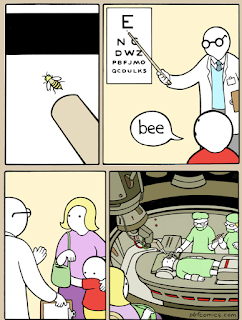
I read the webcomic Trash Mountain created by Kelton Sears. It is a surrealist comic about a Dorito-shaped head man whose home is taken away from him and is forced to go on the run.  This short three part comic combines animated gifs, 3D modeling, live action footage and sound into one. It felt like an experiment, more than something that is meant to be marketed and sold. The message of the comic seems to be anti-corporate. Comics like these encourage people to think outside the box of what is traditionally considered a comic book, because something like this can only be done in a digital format.  Web comics also allow for individual content creators to get their work out there without going through a major publication studio. In general the future of comics is shifting towards a digital platform. People rarely purchase comics anymore, unless if it is for collecting purposes.  I also read a webcomic called the Perry Bible Fellowship created by Nicholas Gurewitch. It ...

Superheroes Reconsidered

For this week, I read Black Panther (2016) written by Ta-Nehisi Coates drawn by Brian Stelfreeze. The protagonist of the story is T'Challa who holds the title of Black Panther. T'Challa is the leader of an advanced African civilization called Wakanda. He consumes a mystical heart shaped herb that gives him the power to see his ancestor, in addition to increased speed, dexterity, stamina, and strength. The Black Panther is a cultural hero originally created by Stan-Lee and Jack Kirby in 1966. What sets Black Panther apart from other superheroes is his position as the King of a Clan, which makes much of the story driven by political narratives. He is both a superhero and a politician. One observation I had was that the comic focuses on the world building instead of being character driven by T'Challa. I find that this creates an immersive world, however it does leave me feeling a bit detached because there is no single character to follow. The art is realistic and the characte...

Women's Comics

I read This One Summer by Mariko Tamaki and Jilian Tamaki. This coming of age story revolves around two girls who meet up during the summer in a small beach town. This comic stands out because of its attention to nuance and its ability to capture the mundane. We are shone the everyday lives of two girls figuring things out. They talk about feelings, love, curiosities... The tone is slow-paced and peaceful. We also see the parallels between the complicated adult life and the teenager's lives that have their own fair share of drama. Although the story had a lot of heart to it, I personally did not find it to be very relatable to me, because when I was their age, I did not think about much and just played outside all day. I did not go through such tumultuous times and self realization to the extent they did. I enjoy the story now because I understand the struggles, however I do see this comic as having a more mature audience.

Manga

I read Osamu Tezuka's manga's Astroboy and Dororo. Astroboy is a series that I grew up with. It follows the story of an android who is created by Dr. Tenma to replace his dead son. I think this piece resonates with a national and worldwide audience especially following the end of WW2, because of its themes of anti-war and industrialization. It is a story of hope and humanness. Atom boy also marks the beginning of Japan's fascination with robots and mecha. Dororo shares a similar theme of recollecting one's human qualities. The story takes place during the Sengoku period, it is about a boy who was born without any features or organs because his father essentially sold his soul in exchange for power to rule the land. He faces discrimination and hardship, but with each triumph over a demon, he gains a bit of humanity back.

Assessment

1. What is your reaction to the text you just read? Batman the Killing Joke by Alan Moore and Brian Bolland is a comic book that takes the Batman story and tells it from the Joker's perspective. It was mature, at the same time the colors and panels were exciting and colorful. The tone of it was that of satire and drama instead of the usual high action we are used to seeing in superhero comics. It explores the Joker's backstory as well as takes a closer look at his codependent relationship with Batman. 2. What connections did you make with the work you just read? Discuss the elements of the work with which you were able to connect. In this comic, I was able to relate to the Joker more than I could relate to Batman or the other characters. The story introduces some sympathetic elements such as how he was jobless, with a wife who was pregnant, and no one laughed at his jokes. Although he was a psychopathic murderer, and I do not agree with his actions, the motives behind his ...

Contemporary Comics

This week I read, My Favorite Thing is Monsters by Emil Ferris and  Asterios Polyp  by David Mazzucchelli.  My Favorite thing is Monsters takes the form of a girl's drawings in her journal. They are very detailed and rendered in ballpoint pen. The comic does not really follow the comic book format. There are long paragraphs of narration, while the detailed visuals give us insight into her mind. She caricatures herself as a little monster as well. The organization of the comic is like a scrapbook, which makes it feel like a stream of consciousness, organic flow of doodles. On one hand this makes the comic feel personal, like we are looking into her mind, on the other hand, the story is hard to follow and the main character feels like an unreliable narrator. As her narratives are riddled with fantastical creatures, and the story is only told from her perspective.  Asterios Polyp had a very graphic and simplistic style that added to the appeal of the comic. Mazzuc...

European Comics

For this week, I read  Persepolis by  Marjane Satrapi The story is set in 1980, Iran. She writes about growing up during a time of religious turmoil and social reform. She grew up thinking she was the next prophet, here to rescue humanity. She desired fairness and justice. On one hand she is very religious, on the other hand her parents are progressive and actively participated in the protests. She becomes close to her Uncle as he teacher her a lot about the world. However, he was believed to by a spy by the Iranian government and was executed. This affects Marjane a lot as a child. She goes through hardships and is separated from her loved ones. The story does well to capture the life of a child growing up in social unrest. It captures the conflict she feels because she wants the best for her country but and the same time disagrees with how her people are being negatively affected. The style it is drawn in is simplistic and graphic, in almost a child-like manner. It only has ...

Stereotypes, representation

This week, I read March by John Lewis, Andrew Aydin, and Nate Powell. It is a memoir of the congressman John Lewis as he recounts his upbringing up until the day of inauguration of President Obama. John had a strict upbringing. And it was clear that he was an oddball unlike the rest of his family. He valued education and even went against his father's demands to go to school instead of staying at home to help with the farm. He also was a preacher. He preached to his chickens ever since he was young, and held funerals for them when they died. He becomes one of the youngest preachers and goes to meet Dr. Martin Luther King Jr. He participates in the lunch counter non-violent sit ins to desegregate America. And after much tension, on May 10, 1960 six Nashville restaurants served food to black people. This was a great triumph for desegregation. His story proves how difficult freedom can be, and how resistant people can be to change when they hold themselves superior to others. Racism i...

MAUS

Maus is a graphic novel by Art Speigelman. It depicts his father's experiences during the Holocaust as a Jew. The story is written in an interview style, where it interlaces the dialogues with his father in the present and his father's accounts of the war. This type of writing gives the narrative a second layer. When the story gets too dark, we get a moment of relief from the bleakness and get an insight on the characters peaceful lives now completely different from the horrors of the holocaust. It also suspends us mid action and makes us want to know what happens next. Although moments like this become less as less frequent as the story goes on, it becomes more of a continuous narrative with his father as the main character. Maus gives us a new lens to understand the Holocaust through the medium of the graphic novel, using unique visuals and storytelling techniques. The interesting element of Maus is how it uses animals in the place of human characters as a metaphor. He port...

Underground Comics

Underground comics was a movement between the 1960's and 70's that diverged from mainstream comic books. These comic strips often contained offensive, sexual, and violent content. Reading the comic Zap, I find that   a lot of the humor is satirical and quite dry. Oftentimes the punchline did not hit for me. It could be that times have changed and what people found humorous back then is not what we find humorous today. There are stories that seem to be offensive solely for the sake of being offensive. I also found that many stories did not feel very linear and did not have a clear beginning, middle and end. The stories were mostly text heavy, and did not have a clear focus. Underground comics did allow for comic artists to not be censored, and publish stories not accepted in the public eye. The comic Girl Fight, for example was an early feminist comic that centered around strong female characters. There is still sex and nudity in the comic, but it portrayed women as being ...

WILL EISNER

This week I read some Will Eisner comics including A Contract With God and Blankets . Will Eisner's style of comics is grungy and reveals the darker side of the human condition. His lines are harsh yet flow freely and are very expressive. Blankets is a coming of age story that is told through a boy who feels rather trapped by his family's economic situation, and the oppression he faces at school and from his parents. His relationship with his little brother is not one without conflict, but you can tell that they rely on one another. Later on, Craig grows up and recalls moments from his childhood that relate to a problem he is struggling with in the present. Another relationship he continuously struggles with in the story is with God. As he grows up he harbors certain feelings of shame and guilt because he is condemned by figures of having sinned. This ties into the narrative of  A Contract With God, the main character is let down again and again by his faith after being a devo...

Tintin

      This week, I read the Adventures of Tintin, Tintin in Tibet,  as well as some EC comics, such as Two-Fisted Tales. Tintin in Tibet, made in 1960, follows the story of Tintin looking for his friend in Tibet. It is a 68 page story that follows a story structure that we are familiar with that has a beginning, middle, and end. It is adventurous and spontaneous, and has many interesting characters. Tintin is a strong-headed teenager who does not fear any adventure. About 1/3 of the panel is made up of the text. The panels vary in different sizes, although each page always has 4 rows of panels. My favorite part of this comic was following the different countries and locations that Tintin travels to, such as India, Nepal, Geneva etc. Seeing these locations that I would hope to go to myself some day.       EC comics, on the other hand contain darker themes, and are intended for a mature audience. For example, the Two-Fisted Tales issue I read (Vol.1 No....

Response to comics

Today, I picked up and read Prince Valiant by Hal Foster, Tarzan by Edgar Rice Burroughs, and Gasoline Alley by Frank King, as well as some more Little Nemo in large format. I can say that reading these comics in large format on paper really improved the viewing experience for me. This is because the words are easier to make out, my eyes are able to more easily follow the panels, and it allows me to appreciate the artwork in a more organic, palpable way. Prince Valiant caught my eye because of the art, and the high fantasy setting. Oftentimes, I feel like high fantasy stories are too cliche and follow the same tropes and storylines. But Prince Valiant felt humorous and grounded because of the well developed characters. They don't seem to take themselves too seriously even when serious things may be happening. Prince Valiant uses his wits to win in desperate situations, and even if he doesn't win, there does not seem to be life threatening consequences. Unlike most weekly new...

Week 3

For this week, I read the comics Little Nemo by Windsor McKay, Krazy Kat by George Herriman, Peanuts by Schulz, and Calvin and Hobbes by Bill Watterson. Each comic reflected their respective times and purposes. First, Little Nemo delved into the world of a child's dreams. It is in full color and features fantastical backgrounds and environments. It feels like a more sophisticated comic because of this. When I read it, I feel like I am going on a grand adventure with Little Nemo . The panels are varied in shapes and sizes, and the characters are often small in comparison to the backgrounds. It is clear that Little Nemo in Slumberland was made in older times due to the racist depictions of African characters. Through this we can see that these were times when racism was comedic and widely accepted. Krazy Kat , by Geroge Herriman is about the interactions between a cat and a mouse. Krazy Kat is in love with the mouse, called Ignatz, however Ignatz constantly makes fun of him. Ther...

Understanding comics

Scott McCloud's Understanding Comics talks about icons in media, and how a comic is compromised of a sequence of images. He argues that simplicity can create associate to certain concepts. An icon is a representation or symbol. When something is more simple, it makes it more accessible to a wider array of people. On the otherhand, an image that is more photorealistic gives it a more physical definition instead of conceptual. He talks about how as people, we tend to see ourselves in our surroundings. It makes sense that our brains automatically associate observations with imagery that we are already familiar with. McCloud also talks about time. A spread of panels cannot be happening at the same time. He thinks of time as a rope, stringing together the actions into a coherent sequence based on the order they are read in. He talks about several concepts and theories in a relatively short amount of pages that it could have taken for such elaborate ideas. The style that McCloud draws in...

The Arrival

The Arrival by Shaun Tan is surreal take on the experience of an immigrant. The comic features vast environments with mythical creatures that do well to show what it is like migrating to a foreign country. The graphic novel is wordless, yet it conveys a story through sequences of images that illustrate certain emotions, situations, and reactions.